Paid Ads · 1 October 2026 · 25 min read
What are ads? Types, benefits, paid ads vs organic SEO and LLMO SEO
Educational guide covering digital advertising types, benefits and limitations of paid ads, organic SEO vs paid search, advertising budgets, LLMO SEO and the latest 2026 SEO trends.
Quick answer
Businesses use paid advertising for controlled visibility and organic SEO for long-term search presence. LLMO SEO extends traditional optimization for AI-driven search. The most effective strategies combine paid ads, organic SEO and AI-search optimization based on business goals, economics and timeline.
Introduction: paid visibility vs organic visibility
Businesses operating in the digital landscape generally have two primary avenues to achieve visibility in search engines and across the internet: paid visibility and organic visibility. Paid advertising allows a business to explicitly pay a platform, such as Google, for prominent ad placements. Organic visibility, commonly driven by Search Engine Optimization (SEO), involves structuring web pages and content so that search engines naturally rank them highly in their unpaid results.
It is crucial to understand that these are entirely different systems. Buying ads does not directly purchase organic search rankings, and having excellent organic rankings does not remove the potential utility of paid ads. A comprehensive marketing approach often leverages a combined strategy, including [Google Ads](/paid-advertising/google-ads), [SEO Services](/seo-services), comprehensive [Blogging & Copywriting](/content-marketing/blogging-copywriting), and emerging tactics like [LLMO](/ai-seo/llmo). Neither approach is universally superior; their effectiveness depends entirely on a business's goals, available budget, and desired timelines.
What are ads?
At its core, an advertisement is a paid communication designed to promote a product, service, or brand to a specifically selected audience. In the digital realm, advertising involves utilizing various online platforms to deliver these promotional messages to potential customers who are either actively searching for related solutions or passively consuming content.
Digital advertising spans numerous formats and channels. Some of the most prominent examples include:
Common Digital Advertising Types
- Google Search Ads: Text-based advertisements appearing alongside organic search results.
- Display Ads: Visual banner ads shown across millions of websites and applications.
- YouTube Ads: Video advertisements playing before, during, or after video content.
- Shopping Ads: Product-specific advertisements displaying images, prices, and store information.
- Social Media Ads: Promotional posts and visuals on networks like Facebook, LinkedIn, and Instagram.
- App Ads: Campaigns designed specifically to drive application installations and engagement.
- Native Advertising: Sponsored content designed to seamlessly blend in with a publisher's organic content.
- Local Advertising: Hyper-targeted ads focusing on users in specific geographic locations.
- Remarketing/Retargeting: Ads shown specifically to users who have previously interacted with a business's website or app.
In all these formats, advertisers compensate the platform based on a pre-defined pricing and bidding model—such as cost-per-click (CPC) or cost-per-thousand-impressions (CPM)—aligned with their specific campaign objectives.
Why businesses use advertising
Businesses invest capital into digital advertising to achieve a variety of strategic outcomes. The most common purposes include:
Primary Advertising Purposes
- Brand Awareness: Introducing a brand, product, or service to a new, broader audience.
- Website Traffic: Driving targeted visitors to specific landing pages or e-commerce stores.
- Lead Generation: Capturing user information (like emails or phone numbers) for future sales outreach.
- Sales and Revenue: Directly encouraging users to make immediate online purchases.
- App Installs: Prompting users to download and open mobile applications.
- Local Visits: Encouraging foot traffic to physical retail stores or service locations.
- Remarketing: Re-engaging past visitors to complete a purchase or take another desired action.
- Product Discovery: Showcasing new products to audiences who may not know they exist.
- Demand Generation: Stimulating interest and building a pipeline of future buyers before they actively search.
Benefits of paid advertising
Paid advertising offers several distinct advantages that make it an attractive component of a digital strategy. One primary benefit is faster exposure. While setting up campaigns, creating assets, and passing platform approvals takes some time, ads can begin displaying to target audiences shortly after launch. It is important to note, however, that immediate visibility does not guarantee immediate profitable results.
Another major benefit is precision targeting. Digital platforms allow advertisers to narrow their focus based on search intent, specific audiences, geography, device usage, demographics, user interests, and first-party data. This ensures messages are delivered to highly relevant groups.
Budget control is also a significant advantage. Advertisers can set strict daily budgets, total campaign budgets, and employ various bid strategies. However, setting a budget merely controls the maximum spend; it does not guarantee a specific return on that spend. Measurability is another strong point, as platforms provide detailed metrics on impressions, clicks, cost, and—depending on the accuracy of conversion tracking—conversions and Return on Ad Spend (ROAS).
Finally, digital ads allow for rigorous testing of headlines, images, landing pages, and audiences, facilitating data-driven optimization. When the underlying economics of a campaign are profitable, paid advertising offers scalability, allowing businesses to increase spend to acquire more customers, though scaling does not universally guarantee that ROI will remain strictly linear.
Limitations of paid advertising
Despite its benefits, paid advertising carries significant limitations. The most critical limitation is the ongoing cost constraint: when the advertising budget runs out or the campaign is paused, the paid visibility and associated traffic stop immediately. This is fundamentally different from the enduring nature of organic SEO.
Advertisers also face intense competition, which often leads to rising click costs over time in saturated markets. Budget waste is a common issue, frequently resulting from poor targeting configurations, weak landing pages that fail to convert visitors, or ad fatigue where audiences stop responding to overused creatives.
Additionally, modern advertising is constrained by tracking limitations caused by user privacy updates and platform policies. Businesses must also be mindful of their dependence on ad platforms, as sudden policy changes or account suspensions can disrupt a primary source of revenue.
Search Ads
Search ads are primarily text-based advertisements that appear on search engine results pages (SERPs) when users type specific queries. These campaigns rely heavily on capturing existing search intent. Advertisers select relevant keywords and manage search terms to ensure their ads trigger for appropriate user queries.
Success in search advertising requires compelling ad assets (headlines, descriptions, and site links), highly relevant landing pages that fulfill the user's intent, and robust conversion tracking to measure the precise impact of the ad spend.
Display Ads
Display advertising involves placing visual ads—such as banners, images, and rich media—across vast networks of websites, applications, and Google-owned properties. These ads are typically less about capturing immediate search intent and more about building brand awareness and targeting specific audience profiles.
Modern display campaigns often utilize responsive display ads, which automatically adjust their size, appearance, and format to fit available ad spaces. Retargeting is heavily reliant on display networks to show visual reminders to previous website visitors as they browse other sites.
Video Ads
Video advertising, predominantly run on platforms like YouTube and partner sites, utilizes moving visuals and audio to capture attention. Formats range from skippable and non-skippable in-stream ads to short-form video ads tailored for mobile consumption.
Video ads are highly versatile, capable of driving top-of-funnel brand awareness or bottom-of-funnel conversions depending on the campaign setup, targeting, and the call-to-action presented in the video creative.
Shopping Ads
Shopping campaigns are essential for e-commerce businesses. Instead of relying solely on text, these ads feature a product image, title, price, store name, and other rich product information directly in the search results.
These ads give users a strong sense of the product before they even click, which often leads to highly qualified traffic. They are driven by product data feeds rather than traditional keyword targeting, making feed optimization a critical task for e-commerce marketers.
Performance Max
Performance Max (PMax) is a goal-based campaign type that allows advertisers to access all of their Google Ads inventory—Search, YouTube, Display, Discover, Gmail, and Maps—from a single campaign. Instead of manual ad creation per channel, advertisers provide asset groups (images, videos, headlines, descriptions) and audience signals.
Google's AI then dynamically assembles these assets and utilizes Smart Bidding to optimize performance based on the advertiser's specified goals. While powerful, it is important to understand that PMax relies heavily on machine learning and does not automatically guarantee better performance than meticulously managed manual campaigns.
Demand Gen
Demand Gen campaigns replaced the older Discovery campaigns, designed to serve visual, immersive advertising across YouTube (including Shorts), Discover, Gmail, and the Display Network. These campaigns focus heavily on demand creation, engaging users before they begin actively searching for a solution.
They leverage product feeds, audience targeting, and high-quality visual creatives to spark interest and drive engagement among targeted user segments.
App campaigns
App campaigns are specialized formats designed exclusively for mobile applications. Their primary objectives are to drive app installs, encourage specific in-app actions, or foster user engagement. These campaigns utilize Google AI to distribute ads across Search, Google Play, YouTube, and the Discover network, optimizing bids and targeting automatically based on the app's performance goals.
Native, local and remarketing ads
Native ads are designed to match the visual design and function of the platform upon which they appear, often blending in with surrounding editorial content to provide a less intrusive user experience. Local ads are hyper-focused on reaching users within specific geographic boundaries, making them vital for brick-and-mortar businesses.
Remarketing (or retargeting) campaigns specifically target users who have previously interacted with a brand, subject to platform rules, user consent, and data privacy regulations. These ads are highly effective for bringing users back to complete a transaction.
Types of digital ads — comparison
| Ad Type | Main Purpose | Typical Environment | Useful For | Main Limitation |
|---|---|---|---|---|
| Search | Capture intent | Search engine results | Direct response, leads | Can be highly competitive and expensive |
| Display | Awareness | Websites and apps | Brand building, retargeting | Lower click-through rates |
| Video | Engagement | YouTube, video platforms | Storytelling, awareness | Requires high-quality video production |
| Shopping | E-commerce sales | Search engine results | Physical products | Requires structured product feed |
| Performance Max | Goal optimization | Across Google networks | Maximizing total conversions | Less manual control and visibility |
| Demand Gen | Demand creation | YouTube, Discover, Gmail | Visual discovery | Relies heavily on strong creative assets |
| App | App growth | Play Store, Search, YouTube | Downloads, in-app actions | Limited to mobile applications |
| Social | Audience targeting | Social media feeds | Targeting specific interests | Users are often not actively shopping |
| Native | Content integration | Publisher websites | Content marketing promotion | Can be ignored if not highly relevant |
| Local | Store visits | Maps, Search, Local networks | Brick-and-mortar businesses | Limited by geographic population size |
How much should a business spend on advertising?
There is no universal percentage of revenue or flat number that applies to all businesses. Determining how much to spend on advertising depends heavily on individual business mechanics. Key factors include the business model, current revenue, gross margins, Customer Lifetime Value (CLV), Average Order Value (AOV), and historical conversion rates.
Additionally, the length of the sales cycle, the level of competition, total market size, existing organic traffic volume, current brand awareness, geographic market constraints, and overall cash flow must be considered. Advertising spend should be dictated by calculated Customer Acquisition Cost (CAC) targets and specific return requirements, rather than arbitrary industry benchmarks.
How to set an advertising budget
- 1Define objectiveClearly identify what you are trying to achieve: leads, sales, or awareness.
- 2Calculate acceptable economicsDetermine the maximum amount you can profitably spend to acquire a customer or lead.
- 3Estimate conversion ratesUse historical business data or conservative industry estimates to predict how many clicks will become customers.
- 4Start with a controlled testAllocate a strict, affordable budget to run initial campaigns and gather real-world data.
- 5Measure resultsCarefully track spend, clicks, leads, sales, revenue, conversion rates, and cost per result.
- 6Improve campaignsOptimize targeting, creatives, landing pages, keywords, offers, and bids based on the data.
- 7Scale selectivelyOnly increase the budget when the data provides strong evidence that the underlying economics are sound.
Advertising cost formulas
Understanding basic advertising math is crucial for managing budgets effectively. Important formulas include:
Key Advertising Formulas
- Cost Per Lead (CPL) = Total Ad Spend ÷ Number of Qualified Leads
- Cost Per Acquisition (CPA) = Total Ad Spend ÷ Number of New Customers
- Return on Ad Spend (ROAS) = Total Revenue Generated ÷ Total Ad Spend
It is vital to remember that ROAS is a measure of gross revenue efficiency, not a measure of net profit. A campaign with a high ROAS can still be unprofitable if gross margins are too low to cover operational costs.
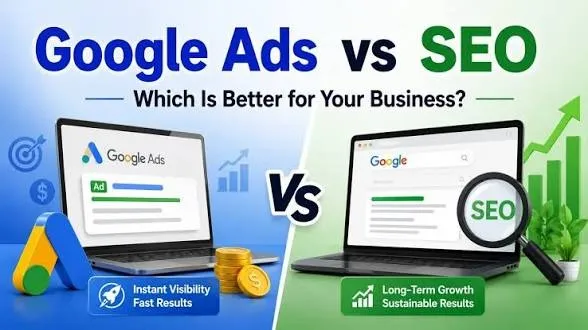
Paid Ads vs organic SEO
The decision between Paid Ads and organic SEO is a choice between two fundamentally different visibility models. Paid search involves purchasing placement directly from the platform. Organic search involves earning placement by demonstrating relevance, authority, and technical soundness to the search engine's algorithms.
It is a common misconception that organic SEO is 'free.' While you do not pay the search engine for clicks, successful SEO requires substantial investment in skilled employees, agencies, high-quality content creation, web development, SEO software tools, technical maintenance, and authoritative link building. Organic visibility is earned through continuous effort and investment, not achieved at zero cost.
Paid advertising vs organic SEO comparison
| Factor | Paid Ads | Organic SEO |
|---|---|---|
| Payment Model | Pay per click or impression | Investment in resources, content, and time |
| Visibility | Immediate upon approval and active budget | Earned over time through ranking improvements |
| Speed | Fast deployment | Slow, compounding growth |
| Longevity | Stops instantly when budget stops | Enduring visibility even if active work pauses |
| Control | High control over message and targeting | Lower control over exact display and rankings |
| Targeting | Precise demographic, geographic, and behavioral | Broadly intent-based through keywords |
| Content Requirement | Landing pages and ad creatives | Comprehensive, high-quality, authoritative assets |
| Competition | Determined by auction bids and quality | Determined by content quality and domain authority |
| Measurement | Highly trackable (with proper setup) | Trackable, but attribution can be complex |
| Main Risk | Budget waste on poor targeting | Algorithm updates dropping rankings |
Is paid advertising better than SEO?
Neither paid advertising nor SEO is universally 'better.' They solve different business problems. Paid ads are highly useful when a business needs controlled, immediate exposure for a specific promotion, is entering a new market rapidly, or needs to aggressively capture high-intent commercial searches where organic competition is currently insurmountable.
Conversely, SEO is incredibly powerful for building long-term, sustainable visibility, capturing early-stage informational queries, establishing brand authority, and reducing blended customer acquisition costs over time. Because of these complementary strengths, many mature businesses utilize both channels simultaneously.
How paid advertising and SEO work together
A robust digital strategy integrates multiple channels. Paid Search captures immediate, high-intent demand and provides rapid testing data. Organic SEO builds a foundation of long-term visibility. Quality content marketing answers informational searches early in the buyer's journey. [Local SEO](/seo-services/local-seo) captures localized demand for physical locations.
Meanwhile, social media builds broader brand awareness, and email/CRM systems nurture the leads generated by all these channels. When paid and organic teams share data—such as which search terms convert best—both channels perform significantly better.
Can ads improve organic Google rankings?
To be absolutely clear: Google's paid and organic systems are entirely separate. Buying Google Ads does not directly improve your organic rankings. You cannot purchase organic placement.
However, running ads can have indirect effects. Widespread brand exposure through ads can lead to increased branded searches, which is a positive signal. Ads also allow for rapid testing of messaging and landing page experiences; the insights gained from these tests can be applied to improve organic content. But these are secondary effects; there is no automatic, algorithmic ranking boost granted for spending money on ads.
How Google Ads auctions work
The Google Ads auction is not simply a system where the highest bidder always wins. When a search occurs, Google calculates an Ad Rank for every eligible ad. The verified 2026 formula for this is:
Ad Rank = f(Bid, Quality Score, Ad Rank Thresholds, Search Context, Expected Asset Impact).
Quality Score itself comprises three critical components: Expected Click-Through Rate (CTR), Ad Relevance to the search query, and the Landing Page Experience. Therefore, a highly relevant ad pointing to an excellent landing page can often outrank a competitor with a higher bid but lower quality.
Why some ads cost more than others
The cost of advertising varies wildly based on numerous factors. High commercial intent queries in lucrative industries (like legal or financial services) will naturally have higher click costs due to intense competition and the high value of a resulting customer.
Costs are also influenced by geographic targeting, overall search demand, the quality of the advertiser's setup, campaign goals, and real-time auction conditions. There are no fixed CPC tables; the market dictates the price dynamically.
Why landing pages matter for advertising
A landing page is where the user arrives after clicking an ad. Its quality directly impacts the Google Ads Quality Score and the ultimate conversion rate of the campaign. A successful landing page must be highly relevant to the specific search intent that triggered the ad.
Google evaluates page experience holistically, functioning as a tiebreaker in competitive situations. Key components include fast loading speeds (measured by Core Web Vitals), secure HTTPS connections, robust mobile usability, and a lack of intrusive interstitials. Clear information, prominent trust signals, and a friction-free conversion path are essential for maximizing the return on ad spend.
What is SEO?
Search Engine Optimization (SEO) is the systematic process of improving a website so that search engines can easily understand its purpose and users can find highly useful information through organic search results. A comprehensive SEO strategy involves numerous disciplines.
These include [Technical SEO](/seo-services/technical-seo) to ensure crawlability, on-page optimization for topical relevance, content creation to satisfy user intent, strategic internal linking, image optimization, structured data implementation, off-page authority building, and focusing heavily on the overall user experience.
Traditional SEO fundamentals
Traditional SEO relies on proven fundamentals: thorough keyword research, aligning content strictly with search intent, optimizing title tags and headings, and building clear internal linking structures. Technical soundness is non-negotiable, requiring proper indexing, sensible URL structures, correct canonicalization, optimized XML sitemaps, and robots.txt configurations.
Furthermore, traditional SEO emphasizes mobile-first performance, page speed optimization, the use of schema structured data, local SEO signals for physical businesses, and the continuous monitoring of technical health via Google Search Console. It emphatically does not involve outdated tricks or manipulative link schemes.
What is LLMO SEO?
LLMO stands for Large Language Model Optimization. It is important to note that this is an emerging industry term and is not a standardized or official Google ranking system. In practical terms, LLMO refers to the practice of structuring and optimizing information so that AI and LLM systems can effectively understand, retrieve, summarize, and potentially reference a brand in their conversational outputs.
It is crucial to distinguish between various industry terms. Traditional SEO focuses on classic search engine algorithms. Concepts like [AI SEO](/ai-seo), [LLM SEO](/ai-seo/llm-seo), [LLMO](/ai-seo/llmo), [GEO SEO](/ai-seo/geo-seo), and [Answer Engine Optimization (AEO)](/ai-seo/answer-engine-optimization) represent evolving strategies to address AI-driven search, though they lack perfectly standardized, universally agreed-upon definitions across the industry.
Traditional SEO vs LLMO-oriented optimization
| Area | Traditional SEO | LLMO-oriented Optimization |
|---|---|---|
| Main Environment | Classic search engine results pages (SERPs) | AI Overviews, conversational chat interfaces |
| Primary Concern | Ranking blue links | Being included in AI-generated summaries |
| Keywords | Specific query matching | Broad entity and concept relationships |
| Search Intent | Navigational, informational, transactional | Complex, multi-part conversational queries |
| Content | Comprehensive topical coverage | Direct, concise, easily extractable answers |
| Entities | Helpful for context | Critical for accurate AI association |
| Structure | Headings, standard HTML | Highly structured tables, lists, and strict semantic HTML |
| Authority | Links and domain metrics | E-E-A-T, brand mentions, and consensus across the web |
| First-hand Info | Valuable for users | Essential for original insight extraction by AI |
| Citations/Sources | Good practice | Critical for trust and verification by AI systems |
| Structured Data | Used for rich snippets | Crucial for unambiguous machine understanding |
| AI Citation | Not a primary goal | The ultimate goal for visibility |
| Ranking Guarantee | None | None (and highly volatile) |
Why traditional SEO still matters for LLMO
Google's official guidance clearly states that existing SEO best practices continue to be highly relevant for AI Search features. LLMO builds upon the foundation of SEO; it does not replace it. Traditional technical SEO ensures that pages are crawlable and content is indexable, providing the raw data that LLMs rely upon.
Without a clear site structure, search intent alignment, and technically sound foundations, AI systems cannot discover the content in the first place. LLMO simply adds a layer of refinement: providing explicitly clear answers, ensuring entity clarity, heavily citing evidence, highlighting first-hand expertise, providing machine-readable context, and actively monitoring [AI Visibility](/ai-seo/ai-visibility).
How to transition from traditional SEO to LLMO
- 1Keep technical SEOMaintain a flawless technical foundation to ensure uninterrupted crawling and indexing.
- 2Move to entity thinkingShift focus from exact-match keywords to comprehensive topics and clear entity relationships.
- 3Create original informationPublish unique data, first-hand experiences, and original research that AI cannot simply synthesize from existing sources.
- 4Make important info explicitClearly state who you are, what you do, where you operate, and the specific services offered.
- 5Improve content structureUtilize clear semantic headings, data tables, bulleted lists, and well-formatted FAQs for easy machine extraction.
- 6Strengthen evidenceCite authoritative sources, explain methodologies clearly, and keep dates current.
- 7Strengthen entity consistencyEnsure business information is perfectly consistent across all web properties and directories.
- 8Use structured dataImplement relevant schema markup appropriately to provide unambiguous context to search engines.
- 9Optimize multimediaEnsure images and videos are properly optimized with descriptive metadata.
- 10Make content easy to retrieveBuild robust internal linking structures and organize content into logical topic clusters.
- 11Build topical depthCover subjects comprehensively to establish your domain as a definitive authority.
- 12Monitor AI visibilityRegularly check how your brand is referenced in AI Overviews and conversational interfaces.
What not to do for LLMO
As with traditional SEO, there are practices to strictly avoid when optimizing for LLMs. Do not engage in keyword stuffing or attempt to embed hidden AI instructions in your code or text. Faking citations, reviews, or topical authority will ultimately harm trust. Generating mass, low-value AI pages to flood the index is strongly discouraged.
Warning on AI Optimization Hacks
Google explicitly warns against supposed AEO or GEO 'hacks'. Avoid manipulative brand mentions, spammy backlinks, creating fake entities, making unsupported claims, or guaranteeing citations. There is no reliable shortcut to earning trust in AI retrieval systems.
llms.txt explained
The `llms.txt` file has gained attention in developer communities, but it is critical to understand its role regarding search. According to Google's official documentation, an `llms.txt` file is NOT needed for Google Search and will not positively or negatively affect Google Search visibility or rankings.
While it may be useful for providing context to specific, independent agentic systems or developer tools, you should not advise readers or clients to create it under the false pretense that it is a Google ranking factor or a requirement for SEO. For more details, refer to our [llms.txt guide](/blog/llms-txt-guide).
Content for AI Search
Creating content that performs well in AI-driven search environments requires precision. Focus on providing direct answers and clear, unambiguous definitions early in the text. Emphasize original information and structure the page logically.
Providing verifiable evidence, clearly establishing author and business identity, and keeping information fresh are vital. Use highly relevant examples, maintain consistent terminology throughout, and build strong, comprehensive topical coverage. It is vital to note that no strategy can definitively guarantee AI citations or inclusion in summaries.
Advertising and AI Search
Advertising is rapidly evolving alongside AI Search capabilities. At Google Marketing Live 2026 (May 20, 2026), several significant advancements were announced, detailing how paid search is adapting to conversational interfaces.
These included the introduction of ads in AI Mode, highly conversational discovery ads, highlighted promotional answers, and a pilot program in India for a business agent designed to capture leads directly within search. The availability of these AI-powered advertising tools heavily depends on the specific market, account status, and regional rollouts.
AI Mode advertising
Google has formally announced ad experiences operating within 'AI Mode.' This represents a shift from traditional search interfaces (standard blue links combined with top-of-page text ads) to AI-assisted search experiences, which feature conversational responses that may naturally integrate promotional messaging.
This includes conversational discovery ads and highlighted answers that blend organic synthesis with paid placement. While the landscape is shifting, advertisers should focus on providing high-quality feed data and clear assets rather than speculating on the exact, long-term behavior of these developing formats.
AI Max for Search campaigns
AI Max for Search acts as an advanced optimization layer applied to existing Search campaigns. It leverages broad match technology, automatically created assets (ACA), and dynamic landing page matching to improve relevance and performance.
It provides AI-assisted search matching, search expansion capabilities, and advanced automation while retaining advertiser controls. Notably, the forced migration of Dynamic Search Ads (DSA) to AI Max was delayed to February 2027. Additionally, the AI Brief feature was expanded to support multiple languages in September 2026.
Paid search, organic SEO and AI search
A modern visibility strategy relies on three distinct but complementary pillars. Paid Search provides the mechanism to explicitly pay for ad opportunities and immediate exposure. Organic SEO focuses on earning traditional organic visibility through technical health, authority, and content quality.
AI Search and LLMO represent a third pillar focused on improving clarity, structuring data for machine-understandability, and earning placement in generative summaries. These are not interchangeable systems; they are parallel strategies that support a comprehensive digital presence.
Latest SEO trends in 2026
The SEO landscape in 2026 is heavily influenced by the integration of artificial intelligence and shifting user behaviors. Key trends include the widespread prominence of [AI Overviews](/ai-seo/ai-overviews) and the expansion of Generative AI Search interfaces. Multimodal search—allowing users to search via Lens, Circle to Search, and direct image or video uploads—has become a standard behavioral pattern.
There is a massive emphasis on original content and demonstrating first-hand expertise, aligning with Google's E-E-A-T framework where Trust is central. Entity understanding and the meticulous use of structured data are more critical than ever for clarifying context to [AI Retrieval Systems](/ai-seo/ai-retrieval-systems).
Technical SEO remains foundational, with strict adherence to Core Web Vitals thresholds (LCP ≤ 2.5s, INP ≤ 200ms, CLS ≤ 0.1, measured at the 75th percentile). Mobile experience, video search optimization, visual search, and localized signals continue to evolve. Furthermore, we are seeing the rise of Agentic Search, AI-powered shopping experiences, and enhanced content authenticity measures to combat spam. Human-plus-AI workflows have become the standard for modern marketing teams.
Multimodal Search
Search is no longer confined to text boxes. Multimodal search allows users to combine text, images, Google Lens, Circle to Search, and video inputs to find information. In September 2026, Google Search Console introduced multimodal search performance reporting, allowing webmasters to track traffic from Lens and image uploads, though the specific Queries dimension was disabled for this multimodal traffic due to privacy and complexity. Note that full multimodal capabilities are not yet uniformly available in every global country.
SEO and video
Video content plays a massive role in modern search behavior. Optimizing for YouTube, Google Search video features, short-form video platforms, and Visual Search is essential for brands producing multimedia. Useful video strongly complements written SEO efforts by increasing engagement and catering to different learning styles. However, simply embedding a video on a page does not automatically guarantee that the page will rank higher in standard text results.
SEO and local search
For businesses serving specific geographic areas, local SEO remains distinct and critical. Success relies on a meticulously maintained Google Business Profile, highly relevant local landing pages, perfect consistency of business information (Name, Address, Phone number) across the web, and a steady stream of authentic customer reviews.
Creating locally focused content that addresses specific local intent is also vital for visibility in Google Maps and localized Search results. There is no single factor or 'hack' that guarantees local ranking dominance.
SEO and content quality
Quality remains the ultimate determinant of SEO success. High-quality content directly answers the user's actual questions, provides original value not found elsewhere, is factually accurate, easy to understand, and regularly maintained. It clearly demonstrates expertise and actively avoids unnecessary filler.
It is a common misconception that word count equals quality. A concise, highly accurate 500-word answer is significantly better for SEO than a rambling, repetitive 3,000-word article that fails to address the user's core intent.
AI-generated content and SEO
Artificial Intelligence is a powerful tool for research, brainstorming, outlining, drafting, and editing content. However, businesses must rigorously review all AI-assisted content for factual accuracy, originality, brand voice alignment, demonstration of actual expertise, and potential legal or copyright issues.
Google's guidance indicates that AI-generated content is not automatically penalized simply for being AI-generated, provided it is genuinely helpful. Conversely, using AI does not mean content automatically ranks. We strongly advise against producing mass volumes of low-value, unedited AI content in an attempt to manipulate search rankings.
When to use paid advertising vs SEO
Deciding where to allocate resources requires a clear framework. Use paid advertising when you require strictly controlled exposure, have a measurable and immediate goal, possess a highly relevant landing page, have precise conversion tracking in place, and when your customer acquisition economics confidently support the ad spend.
Invest in SEO when there is proven, consistent search demand, when long-term compounding visibility is a priority, when you have the resources to invest in content and technical infrastructure, and when you want to build a sustainable organic acquisition channel. Use both simultaneously when you desire immediate results while building a long-term asset, when paid testing data can inform organic strategy, and to capture users at different stages of complex customer journeys.
Example: a local web-development company
Fictional Case Study
Consider a fictional local web-development company. For immediate leads, they utilize highly targeted Google Search Ads focusing on terms like 'web developer near me' within a 20-mile radius. For long-term organic visibility, they build comprehensive service pages and educational content about [WordPress Development](/web-design-development/wordpress-development). Their local strategy focuses on maintaining a flawless Google Business Profile. For LLMO, they ensure their services, expertise, locations, and brand identity are explicitly clear and consistently cited. They measure success by tracking ad spend against qualified leads, alongside monitoring organic traffic growth and localized search visibility.
Example: an e-commerce business
Fictional Case Study
A fictional e-commerce business relies heavily on Shopping Ads and Performance Max campaigns to drive direct product sales. Simultaneously, they invest in organic SEO by optimizing category structures, enhancing product pages with detailed descriptions, and implementing comprehensive product schema markup. They actively gather authentic product reviews to build trust. They prepare for AI Search by ensuring their product data feeds are exceptionally clean and their technical infrastructure, such as [E-commerce Development](/web-design-development/ecommerce-development) best practices, allows for rapid indexing of new inventory.
Example: a B2B services company
Fictional Case Study
A fictional B2B services company dealing with long sales cycles utilizes Search Ads to capture high-intent enterprise queries, combined with LinkedIn social ads for precise professional targeting. Their organic strategy revolves around deep, technical content, detailed case studies, and whitepapers. Because their sales cycle is long, they rely heavily on lead capture forms, CRM integration, and automated email nurturing sequences (perhaps using [n8n Automation](/automation-ai-agents/n8n-automation)) to turn expensive paid clicks and organic visitors into eventual contracts.
Common advertising mistakes
Avoid These Paid Ad Errors
- Running campaigns with no clearly defined business goal.
- Operating without accurate, verified conversion tracking.
- Sending paid traffic to poor, irrelevant, or slow landing pages.
- Using overly broad targeting without refinement.
- Ignoring the nuances of user search intent.
- Failing to utilize negative keywords to block irrelevant traffic.
- Relying on weak, uninspiring, or repetitive ad creatives.
- Refusing to test new headlines, images, or offers.
- Operating without strict daily or campaign budget controls.
- Stopping tests too quickly before achieving statistical significance.
- Scaling budgets too quickly before economics are proven.
- Measuring success by clicks and impressions rather than actual business outcomes.
- Ignoring the quality of the leads generated.
- Misunderstanding or ignoring complex attribution models.
- Lacking a defined strategy for different audience segments.
- Failing to implement remarketing for past visitors.
- Neglecting mobile optimization for ads and landing pages.
- Presenting a confusing or uncompelling offer.
- Assuming that simply spending more money will automatically yield more profit.
Common SEO mistakes
Avoid These Organic Search Errors
- Keyword stuffing text in an unnatural manner.
- Copying or scraping content from other websites.
- Publishing thin pages with little to no unique value.
- Ignoring the actual intent behind user search queries.
- Neglecting foundational technical SEO and crawlability.
- Having a poor, confusing, or non-existent internal linking structure.
- Tolerating slow-loading pages that fail Core Web Vitals.
- Providing a poor user experience on mobile devices.
- Purchasing fake backlinks or participating in link spam.
- Generating fake reviews or deceptive business information.
- Allowing massive amounts of duplicate content to be indexed.
- Writing poor, automated, or missing metadata.
- Ignoring image optimization and alt text.
- Neglecting local SEO signals for brick-and-mortar locations.
- Failing to monitor technical health in Google Search Console.
- Publishing AI-generated content without rigorous human review.
- Constantly chasing every minor industry trend or rumor.
- Expecting instant, overnight ranking improvements.
- Assuming that once a ranking is achieved, it is permanent.
- Relying on outdated, manipulative SEO tricks from a decade ago.
Common LLMO mistakes
Avoid These AI Search Errors
- Treating LLMO as a system that guarantees exact rankings.
- Viewing LLMO as a complete replacement for traditional SEO.
- Stuffing conversational text with unnatural entity mentions.
- Writing content exclusively for machines while alienating human readers.
- Fabricating fake citations, authority metrics, or reviews.
- Flooding the web with mass, low-value AI-generated content.
- Treating the llms.txt file as a secret Google ranking trick.
- Ignoring the technical SEO foundation required for discovery.
- Ignoring human user experience and readability.
- Failing to verify the quality and accuracy of cited sources.
- Allowing business entity information to become inconsistent.
- Making claims without providing verifiable evidence.
- Failing to provide original information or first-hand insight.
- Falsely claiming to clients that AI citations or overviews are guaranteed.
- Attempting to technically manipulate AI retrieval systems.
- Ignoring factual accuracy and hallucination risks.
- Failing to monitor how the brand is represented in AI outputs.
Measuring paid advertising and SEO
Effective measurement requires understanding the difference between platform metrics and true business outcomes. Paid advertising metrics typically focus on Impressions, Clicks, Click-Through Rate (CTR), Cost Per Click (CPC), Total Spend, Conversions, Cost Per Acquisition (CPA), Conversion Value, and Return on Ad Spend (ROAS).
Organic SEO metrics often focus on Impressions, Clicks, CTR (via Search Console), total organic sessions, specific page performance, organic conversions, and overall search visibility. However, true business metrics bridge the gap: you must ultimately measure Qualified Leads, New Customers, Total Revenue, Customer Acquisition Cost (CAC), Customer Lifetime Value (CLV), and bottom-line profitability. Platform metrics are indicators; business metrics are the actual goal.
Search Console, Google Ads and Google Analytics
It is critical to understand that these are different measurement systems built for different purposes. Google Search Console measures organic search visibility and interactions strictly on Google Search. It does not report paid ad clicks as organic traffic.
Google Ads provides detailed financial and performance data specifically for paid campaigns. Google Analytics attempts to aggregate user behavior across all channels (paid, organic, social, direct) once the user is on the website. Discrepancies between these tools are normal due to different attribution models, privacy blocks, and measurement methodologies.
Paid search data and organic strategy
While running ads does not boost organic rankings, the data generated by paid search is incredibly valuable for organic strategy. Paid campaigns quickly reveal which exact search queries result in the highest conversion rates, highlighting terms that are worth the long-term SEO investment.
Paid data also exposes customer language, which ad copy variations resonate best, and which landing page messaging drives action. This is a strategy observation advantage, providing empirical data to guide the organic [Content Marketing](/content-marketing/blogging-copywriting) roadmap.
Traditional SEO to LLMO transition roadmap
- 1Phase 1: Technical SEO foundationEnsure perfect crawlability, speed, and indexing.
- 2Phase 2: Content qualityAudit existing content for accuracy, depth, and helpfulness.
- 3Phase 3: Search-intent optimizationAlign pages strictly with what users (and AI) are trying to solve.
- 4Phase 4: Entity clarityMake business information, services, and relationships explicitly clear.
- 5Phase 5: Evidence & source qualityAdd authoritative citations, methodologies, and factual backing.
- 6Phase 6: Structured informationImplement robust schema markup and clear HTML structures (tables, lists).
- 7Phase 7: MultimediaOptimize images and video assets for multimodal discovery.
- 8Phase 8: AI-search monitoringBegin tracking brand mentions and sentiment in AI Overviews and chat tools.
- 9Phase 9: Continuous improvementIterate based on performance data and platform changes.
90-day educational plan
For businesses looking to mature their digital presence, a structured 90-day approach is beneficial. Days 1-30 should focus heavily on a comprehensive Technical SEO and content audit, identifying critical errors and baseline metrics. Days 31-60 should transition into active content and entity improvements, restructuring pages for clarity and adding verifiable evidence.
Days 61-90 involve monitoring AI Search and LLMO visibility, refining messaging based on initial observations, and establishing long-term reporting. It is critical to set expectations: this plan builds a foundation; it does not promise guaranteed rankings or massive traffic spikes within 90 days.
How AVR Web Consulting can help
Navigating the complexities of paid advertising, organic search, and emerging AI technologies requires a cohesive strategy. At AVR Web Consulting, we do not make unsupported claims or guarantee arbitrary rankings, leads, or AI citations. Instead, we focus on engineering robust, data-driven systems tailored to your specific business economics.
Whether you need precision management of [Google Ads](/paid-advertising/google-ads), comprehensive [SEO Services](/seo-services), rigorous [Technical SEO](/seo-services/technical-seo), targeted [Local SEO](/seo-services/local-seo), or forward-looking optimization like [AI Visibility](/ai-seo/ai-visibility) and [LLMO](/ai-seo/llmo), we can help. We also offer specialized [Blogging & Copywriting](/content-marketing/blogging-copywriting), strategic [Social Media Ads](/paid-advertising/social-media-ads), and advanced technical solutions including [n8n Automation](/automation-ai-agents/n8n-automation) and custom [AI Agent Development](/automation-ai-agents/ai-agent-development). Contact us to build a digital strategy grounded in reality and driven by results.
Frequently asked questions
Get an AI visibility & SEO audit
Tell us your target keywords and markets. We reply within one business day with findings, priorities and a tailored proposal.