AI SEO · 1 October 2026 · 18 min read
What Is AEO SEO? Benefits, How It Works, and How Traditional SEO Is Evolving
Comprehensive guide to Answer Engine Optimization (AEO). Learn how to structure content for direct answers, featured snippets, and AI-powered search experiences.
Quick answer
Answer Engine Optimization (AEO) focuses on structuring content to directly answer user questions. By providing clear, concise information, AEO helps search engines and AI systems retrieve and present your content as direct answers, enhancing visibility beyond traditional lists of links.
Introduction to Answer Engine Optimization
The way people interact with search engines is undergoing a profound transformation. Instead of typing fragmented keywords and sifting through pages of blue links, users are increasingly asking complete, natural language questions and expecting immediate, direct answers. This shift in user behavior is driving the evolution of search toward [Answer Engine Optimization (AEO)](/ai-seo/aeo).
AEO is not an entirely new discipline meant to replace traditional SEO; rather, it builds upon it. By focusing on structuring content to directly address user queries, AEO helps brands position themselves as authoritative sources in an era where AI-powered search experiences and featured snippets dominate the top of the results page.
What Is AEO?
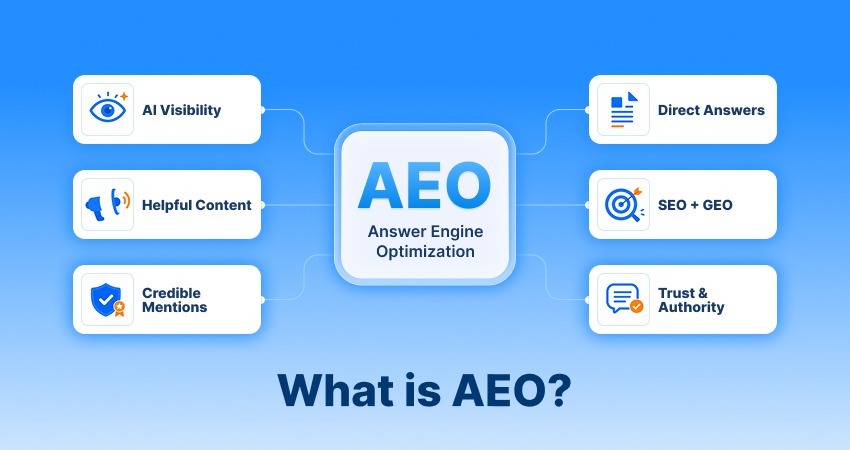
AEO stands for Answer Engine Optimization. It is an industry concept—not an official algorithm—that describes the practice of creating, formatting, and structuring web content so that it can be easily understood and extracted by search engines to provide direct answers to user queries.
In simple terms, AEO means writing your content so clearly and directly that a search engine can instantly pull your answer to display at the very top of the search results.
From a professional standpoint, AEO involves rigorous intent mapping, semantic content structuring, and the use of technical elements like schema markup to ensure that content is disambiguated and optimized for information retrieval systems, including traditional search indexers and modern Large Language Models (LLMs).
What Is an Answer Engine?
An answer engine is a search technology designed specifically to bypass the traditional "ten blue links" paradigm and instead deliver a single, direct, and concise answer to a user's question.
While traditional search engines act as directories guiding users to where information lives, answer engines act as knowledge synthesizers. They read the content on the web, extract the most relevant facts, and present them directly on the search interface. Features like Google's Featured Snippets and emerging AI-driven search experiences are prime examples of answer engine functionalities operating within broader search ecosystems.
How Does AEO SEO Work?
The mechanics of Answer Engine Optimization rely on aligning content structure with the information retrieval processes of modern search systems. The flow generally follows this path:
- 1User QuestionA user submits a query, typically formulated as a complete question (Who, What, Where, When, Why, How).
- 2Intent AnalysisThe search system evaluates the query to determine the exact informational intent and context behind the question.
- 3Identify InformationThe engine scans its index for content that is structurally formatted as an answer to that specific intent.
- 4Retrieve & SynthesizeThe system retrieves the most authoritative, concise, and direct text it can find.
- 5Answer DeliveryThe engine presents the extracted text directly on the results page, often formatted as a paragraph, list, or table.
- 6CitationThe source of the answer is cited with a link back to the publisher's website.
AEO SEO vs Traditional SEO
While AEO and traditional SEO share the same foundation—creating excellent content that satisfies users—their immediate objectives and execution strategies differ. AEO is a specialized subset of SEO.
| Feature | Traditional SEO | AEO SEO |
|---|---|---|
| Primary Goal | Rank high in the organic list of links | Win featured snippets and direct answer placements |
| Keyword Focus | Broad topics and high-volume short-tail keywords | Long-tail, natural language, and question-based queries |
| Content Structure | Comprehensive articles designed for deep reading | Concise, scannable formats with explicit Q&A structures |
| Success Metric | Organic traffic, SERP rank, click-through rate | Visibility in answer boxes, brand authority, citations |
| Target Audience | Users browsing for comprehensive information | Users seeking immediate, factual answers |
How Traditional SEO Evolved Into AEO
The transition from traditional keyword-centric SEO to [AEO](/ai-seo/aeo) has been a gradual evolution driven by advancements in natural language processing and changing user expectations.
The evolution can be broken down into key phases:
- Keyword Era: Optimizing for exact-match phrases and search volume.
- Intent Era: Understanding why a user is searching (informational, navigational, transactional).
- Semantic Era: Providing context around entities and topics rather than just isolated keywords.
- Question Era: Addressing conversational queries driven heavily by the rise of voice search.
- Direct Answer Era: Formatting content to satisfy queries immediately on the SERP (Featured Snippets).
- AI Era: Optimizing for systems that synthesize multi-source information into cohesive responses.
Benefits of AEO SEO
Implementing AEO strategies offers several distinct advantages for brands looking to maintain visibility in an evolving digital landscape:
Key benefits include:
- Enhanced Brand Authority: Being cited as the direct answer positions your brand as an authoritative voice in your industry.
- Improved Intent Alignment: By answering specific questions, you connect with users precisely when they need your expertise.
- Future-Proofing: As search relies more on AI and voice, structurally sound, direct answers are more likely to be utilized.
- Higher Trust: Concise, factual answers build trust with users who value efficiency.
- Better User Experience: Clear formatting helps all visitors quickly find the information they need, reducing bounce rates.
How to Transfer Traditional SEO to AEO SEO
Transitioning your strategy does not mean abandoning traditional [Technical SEO](/seo-services/technical-seo) or link building. It means refining your content creation process to prioritize direct answers. Here is an 11-step guide to making the transition:
- 1Step 1: Audit Existing ContentReview your current top-performing pages to see if they clearly answer user questions or if the answers are buried in long paragraphs.
- 2Step 2: Find the Right QuestionsUse tools like People Also Ask, social listening, and customer service logs to identify the exact questions your audience is asking.
- 3Step 3: Map Intent AccuratelyEnsure that the answers you plan to provide directly match the intent behind the user's question.
- 4Step 4: Create Direct AnswersWrite concise, 40-60 word summaries that directly address the core of the question.
- 5Step 5: Build Question-Led ContentStructure new articles around specific questions, using them as primary headings (H2s).
- 6Step 6: Improve Page StructureUse clear typography, bullet points, and tables to make your answers easily scannable by both users and bots.
- 7Step 7: Develop Topical AuthorityDon't just answer one question; build a comprehensive cluster of content that addresses all related queries in your niche.
- 8Step 8: Maintain Technical SEOEnsure fast load times, mobile responsiveness, and clean architecture so search engines can crawl your site efficiently.
- 9Step 9: Implement Structured DataUse FAQPage and HowTo schema markup to explicitly signal your Q&A formats to search engines.
- 10Step 10: Build Trust and AuthorityDemonstrate E-E-A-T (Experience, Expertise, Authoritativeness, Trustworthiness) by citing credible sources and showcasing author credentials.
- 11Step 11: Monitor and RefineTrack your performance in featured snippets and adjust your content formatting based on what search engines are actively rewarding.
How to Write Content for AEO
Writing for Answer Engine Optimization requires a specific structural approach to ensure clarity and extractability. When optimizing for [Blogging & Copywriting](/content-marketing/blogging-copywriting), follow this inverted pyramid style for your informational sections:
The AEO Content Structure:
- The Question: State the exact question clearly in a prominent heading (H2 or H3).
- The Direct Answer: Immediately follow the heading with a concise, 40-60 word paragraph that directly answers the question without fluff.
- The Explanation: Provide the necessary context, background information, or step-by-step details.
- The Evidence: Support your explanation with data, statistics, or expert quotes.
- The Example: Illustrate the concept with a real-world example or case study.
- Related Information: Guide the user to the next logical question or internal resource.
Types of Content Useful for AEO
Certain content formats naturally lend themselves to Answer Engine Optimization because their inherent structure matches the Q&A format that engines prefer.
Highly effective content types include:
- Frequently Asked Questions (FAQs): Dedicated sections or pages that tackle multiple related questions directly.
- How-To Guides: Step-by-step instructions that are easily parsed into numbered lists for snippet extraction.
- Definitions and Glossaries: Clear, unambiguous explanations of industry terms and concepts.
- Comparison Tables: Structured data comparing products, services, or concepts (e.g., A vs. B).
- Summary Bullet Points: Key takeaways placed at the beginning or end of long-form articles.
AEO and Featured Snippets
Featured snippets are the most visible manifestation of answer engines within traditional search results. AEO is, in many ways, the art of optimizing for these "Position Zero" placements.
When you format content with clear headings, concise direct answers, and logical lists, you provide search engines with the exact structural elements they look for when selecting a featured snippet. While it is impossible to guarantee a snippet placement, adhering to AEO principles dramatically increases the likelihood that your content will be chosen as the definitive answer.
AEO and AI-Powered Search
As search engines integrate large language models to generate synthesized responses, the importance of AEO continues to grow. AI-powered search experiences aim to aggregate facts from multiple sources to provide a unified answer.
To be cited in these AI-generated summaries, your content must be highly factual, clearly structured, and easily digestible. By deploying AEO techniques, you ensure that the AI models can seamlessly extract your data, increasing your chances of being recognized as a source and earning a citation link.
AEO vs AI SEO vs GEO vs LLM SEO
The terminology surrounding the optimization for modern search can be confusing. Here is how AEO relates to other emerging concepts in the field:
| Concept | Focus | Key Difference |
|---|---|---|
| AEO (Answer Engine Optimization) | Structuring content to provide direct, extractable answers. | Highly focused on formatting, featured snippets, and Q&A structures. |
| [AI SEO](/ai-seo) | Broad optimization for all AI-driven search environments. | An umbrella term covering AEO, content generation, and AI visibility strategies. |
| [GEO SEO](/ai-seo/geo-seo) (Generative Engine Optimization) | Optimizing specifically for Generative AI search interfaces. | Focuses on citations, persuasive language, and multi-source synthesis within generative models. |
| [LLM SEO](/ai-seo/llm-seo) | Training and influencing Large Language Models. | Involves deeper technical strategies to ensure brand entities are recognized by the underlying models themselves. |
Latest SEO Trends
Understanding AEO requires recognizing the broader trends currently shaping the SEO industry. The landscape is moving rapidly toward intent-driven, AI-assisted experiences.
Current major trends include:
- The Rise of Zero-Click Searches: Users getting their answers directly on the SERP without clicking through to a website.
- E-E-A-T Prominence: Search engines placing unprecedented weight on Experience, Expertise, Authoritativeness, and Trustworthiness.
- Visual and Video Search Integration: Answers being delivered through multimodal formats, including videos and images.
- Hyper-Personalization: Search results tailored increasingly to individual user history, location, and context.
- Conversational Queries: A continuing shift toward long-tail, conversational phrasing driven by voice assistants and chatbots.
How Businesses Can Prepare for Current SEO Changes
Adapting to AEO and the latest trends requires a proactive approach. Here is a checklist for businesses to prepare for the evolving search landscape:
Preparation Checklist:
- Prioritize User Intent: Focus on why users search, not just what they search.
- Audit Content Quality: Remove or consolidate thin, unhelpful content.
- Implement AEO Formatting: Restructure key pages to include direct answers and clear headings.
- Enhance Technical Foundation: Ensure superior site speed and mobile performance.
- Leverage Structured Data: Implement comprehensive schema markup across your site.
- Build Genuine Authority: Invest in original research, expert authorship, and credible backlinks.
- Focus on Local Nuances: Optimize for [Local SEO](/seo-services/local-seo) if you serve specific geographic areas.
- Diversify Traffic Sources: Don't rely solely on organic search; build direct audiences.
- Monitor AI Developments: Stay informed about how major search engines are updating their AI features.
- Update Old Content: Refresh historical posts with new facts and better AEO structure.
- Invest in Multimedia: Support text answers with relevant images and videos.
- Focus on Brand Building: Ensure your brand is recognized as an entity by search engines.
Common AEO SEO Mistakes
As with any strategic shift, businesses often make errors when trying to implement AEO. Avoiding these pitfalls is crucial for success.
Mistake: Thinking AEO Replaces Traditional SEO
AEO relies on the foundation of traditional SEO. If your site is slow, un-crawlable, or lacks authority, perfectly formatted answers won't help you rank.
Other common mistakes include:
- Keyword Stuffing in Answers: Forcing keywords into a direct answer makes it unnatural and less likely to be featured.
- Making Unsupported Claims: Failing to back up your answers with evidence or data diminishes trust.
- Writing Overly Complex Answers: Using jargon or convoluted sentences prevents easy extraction by search engines.
- Ignoring the Broader Topic: Focusing so narrowly on one question that the page lacks overall topical depth.
Can AI-Generated Content Be Used for AEO?
The use of AI to generate content is a heavily debated topic. While AI tools can be incredibly efficient for drafting and structuring text, relying on them entirely poses significant risks for AEO.
Search engines emphasize unique value and human expertise. AI can help identify common questions and outline structures, but the final content must be carefully reviewed by a human expert. Responsible use involves fact-checking, adjusting the tone to match your brand, and adding unique insights or proprietary data that an AI model cannot generate on its own.
How to Measure AEO SEO
Measuring the success of AEO can be challenging because zero-click searches don't always result in traditional website traffic. However, there are specific metrics you can track to gauge effectiveness.
Key measurement strategies:
- Featured Snippet Visibility: Use SEO tools to track the number of featured snippets your domain owns for target queries.
- Search Impressions: Monitor Google Search Console for increases in impressions on question-based queries, indicating higher visibility.
- Click-Through Rates (CTR): Analyze CTR changes; while some snippets reduce clicks, highly compelling answers can actually increase them.
- Brand Search Volume: Track increases in branded searches, which can indicate that users are discovering your brand through direct answers and returning later.
Future of AEO SEO
The future of AEO is deeply intertwined with the continuous advancement of artificial intelligence and natural language processing. As models become more sophisticated, the ability to extract and synthesize information will only improve.
We can expect search interfaces to become even more conversational and personalized. Brands that consistently provide highly structured, factual, and easily extractable answers will be the ones that maintain visibility, whether through traditional snippets, voice assistants, or immersive AI search environments.
How Our Company Can Help With AEO SEO
Transitioning to an AEO-focused strategy requires a careful balance of technical expertise, content strategy, and industry knowledge. At AVR Web Consulting, we specialize in helping businesses navigate these complex changes.
Our comprehensive [SEO Services](/seo-services) are designed to audit your existing content, identify high-value question queries, and restructure your website to maximize visibility in featured snippets and AI-powered search results. Contact us today to learn how we can help future-proof your digital presence.
Final Takeaway
Answer Engine Optimization is an essential evolution in the digital marketing landscape. By understanding user intent, structuring content to provide direct, clear answers, and maintaining the strong foundational practices of traditional SEO, you can position your brand for sustained visibility and authority in an increasingly AI-driven world.
Frequently asked questions
Get an AI visibility & SEO audit
Tell us your target keywords and markets. We reply within one business day with findings, priorities and a tailored proposal.